20 Years of Digital Transformation

February 6, 2026

This year marks 20 years of Kona Kai Corporation (KKC) helping organizations navigate change through technology. More than a milestone, this anniversary reflects two decades of trust, adaptability, and a consistent focus on business outcomes in an ever-evolving digital landscape. 


When KKC was founded, digital transformation was not yet a common term. Much of the work was called business process optimization. CRM platforms were emerging, cloud was in its infancy, and artificial intelligence was largely theoretical. 


What has remained constant is the challenge organizations face: How do we adopt new technology in a way that truly supports the business and the people who run it? 


From Business Process Optimization to AI-Driven Transformation 


Over the past 20 years, KKC has helped clients understand, plan for, execute, and adapt to new technologies at every stage of maturity. 
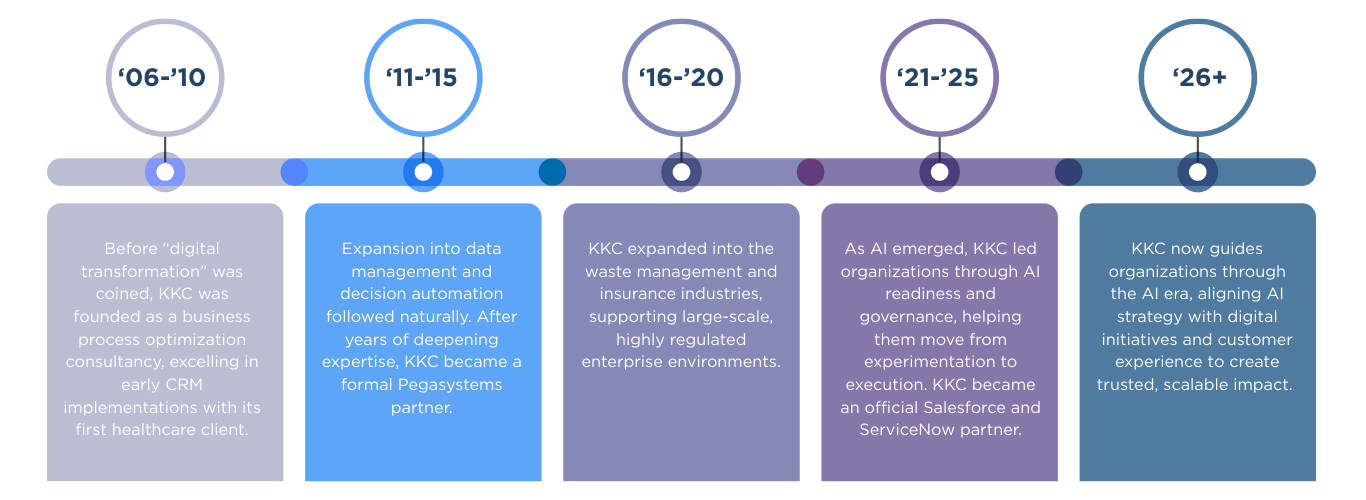
Our work has spanned: 


  • Business process redesign and operational optimization 
  • Early CRM strategy and enterprise CRM implementations 
  • Cloud platform modernization and integration 
  • Data, analytics, and reporting initiatives 
  • AI-enabled workflows and intelligent automation 


AI is the newest evolution, but it is not unfamiliar territory. Just like CRM and cloud before it, success depends on governance, change management, adoption, and alignment with real business processes and, more importantly, intended business outcomes. 


Technology alone does not create transformation. How it is introduced, adopted, and sustained does.


A Boutique Consulting Firm Built on Long-Term Partnerships and Trust 


KKC is a boutique consulting firm by design. That focus allows us to work closely with clients, remain deeply engaged, and build partnerships that last. 


A key milestone is that our original client from 20 years ago is still with us today. Many other client relationships span a decade or more. 


That longevity comes from the value we bring beyond implementation


  • Trusted advisory relationships 
  • Consistent delivery quality 
  • A deep understanding of each client’s business context 
  • Ongoing support as technology and strategy evolve 


We do not approach engagements as transactions. We approach them as partnerships


A Different Delivery Model That Enables, Not Replaces 


Unlike traditional consultancies and large systems integrators, KKC’s delivery model is intentionally structured to enable clients rather than create dependency. 


Our approach emphasizes: 


  • Skill adoption, so internal teams can confidently own and extend their platforms 
  • Change management, ensuring solutions are embraced and used 
  • Process alignment, so technology reflects how work actually happens 


This model helps organizations build long-term capability, not just launch a system. The result is stronger adoption, better ROI, and teams that are prepared to evolve alongside new technology. 


Technology Focused on Business Outcomes 


Across every phase of digital transformation, KKC has remained grounded in one core principle: Technology should serve the business, not the other way around. 


Whether the objective is improving customer experience, increasing operational efficiency, enabling better decision-making, or deploying AI responsibly, success is measured by outcomes, not tools. 


We help clients translate technology investments into real, measurable impact. 


Looking Ahead: The Next Era of Transformation 


As KKC celebrates 20 years in business, the future is as exciting as ever. 


AI presents enormous opportunity, along with new responsibility. The lessons learned from two decades of digital transformation guide how we help clients approach this next chapter: thoughtfully, ethically, and with a strong emphasis on people, process, and governance. 


Thank you to the clients, partners, and teams who have trusted Kona Kai over the past 20 years. The work continues, and the next phase of transformation is already underway. 

INSIGHTS

By Carly Whitte March 15, 2026
Struggling with CRM challenges that are hindering the growth of your business? Don't worry, you're not alone. Discover the most common CRM challenges businesses will face in 2026 and effective solutions to ensure seamless CRM implementation, user adoption, and data management.
By Carly Whitte March 4, 2026
Learn how to build self-serve AI analytics dashboards in CRM. Quick wins, best practices, and expert tips to empower sales and service teams 
By Carly Whitte February 24, 2026
Discover the four levels of AI readiness and assess where your organization stands. Learn how to move from experimentation to scalable, responsible AI adoption.
February 16, 2026
As organizations head into 2026, the conversation around artificial intelligence (AI) is changing. The early years of AI adoption were dominated by experimentation. Proofs of concept multiplied. Vendors promised transformation. Internal teams explored use cases in pockets across the organization. Yet for many enterprises, the results have been uneven at best. In 2026, AI success is more than access to advanced models or cutting-edge tools and will be driven by execution. Organizations that struggle with AI rarely lack ambition but instead lack the structure and organizational readiness. Here’s what you can expect to see in 2026. Agentic AI Goes Beyond Experimentation Agentic AI is often described as the next frontier: AI systems that can reason, plan, and take action autonomously. In theory, this represents a major leap forward. In practice, 2026 will expose a hard truth: autonomy without discipline or readiness creates risk faster than value. The most effective organizations will deploy agentic AI deliberately within clearly defined operational boundaries. Agentic AI will increasingly be used to coordinate workflows, surface decision options, and manage repetitive execution across systems, while humans retain ownership over judgment and accountability. The intelligence of the agent matters far less than how well it is integrated into existing processes and platforms. When agentic AI operates outside governed systems of record, organizations lose visibility, auditability, and trust. When it is embedded directly into the operating model, it strengthens execution and amplifies impact instead of introducing risk. In practice, we are already seeing this distinction play out. One organization attempted to deploy autonomous agents across customer operations without clear escalation paths or system boundaries, quickly creating confusion and rework. Another embedded agentic AI narrowly within its CRM workflows to triage cases, surface next-best actions, and route work, reducing cycle time while preserving human accountability. The difference was the discipline of its deployment and readiness of the company . In 2026, agentic AI will succeed quietly inside workflows , under guardrails, and in service of execution rather than experimentation. The Shift from Models to Systems The advantage of having access to the most advanced AI model will be minimal. Models will improve, but they will also become more interchangeable. The differentiator will be the system surrounding them. Organizations that see real returns from AI will focus on how data moves, how decisions are made, and how outcomes are measured. AI does not operate in isolation. It inherits the strengths and weaknesses of the environment in which it is deployed. At KKC, we often see AI initiatives stall because foundational questions were never addressed. Data may exist, but not be trusted. Platforms may be implemented, but not integrated. Processes may be documented, but not followed. AI simply exposes these gaps faster. We frequently see organizations using the same AI tools achieve radically different outcomes. In one case, two teams implemented similar predictive capabilities. One struggled due to inconsistent data definitions and disconnected platforms. The other succeeded by first aligning data ownership, integrating systems of record, and defining how insights would be acted upon. The technology was identical. The system was not. In 2026, the most successful AI programs will be built on strong systems thinking. They will prioritize reliability over novelty and consistency over speed. These organizations may appear slower at first, but they will compound value over time while others reset their strategy yet again. Governance and Accountability Take Center Stage AI governance is now a practical requirement. As AI moves deeper into decision-making, organizations will face growing pressure to explain how outcomes are generated, who is responsible for them, and how risks are managed. This pressure will come not only from regulators, but from customers, boards, and internal teams who expect clarity and control. Effective governance doesn’t limit innovation; it enables it to scale safely. Organizations that invest in clear ownership models, defined approval paths, and ongoing monitoring will move faster because they eliminate uncertainty and rework. In regulated and complex environments, governance determines speed. Organizations without clear ownership stall decisions while debating risk. Those with defined approval models, monitoring, and escalation paths move faster because teams know exactly how to proceed. Governance removes friction while not slowing AI down. In 2026, governance will be recognized as infrastructure instead of overhead. AI Readiness Is No Longer Just Technical One of the most underestimated shifts heading into 2026 is the recognition that AI readiness is as much about people as it is about technology. Many organizations underestimate the cultural impact of AI. Teams may distrust outputs they do not understand. Leaders may struggle to explain how AI fits into decision-making. Employees may fear replacement rather than augmentation. When these concerns are not addressed, adoption stalls, even when the technology works. In several organizations we’ve observed, AI tools technically performed as designed but were quietly ignored. Teams lacked confidence in outputs, managers hesitated to rely on recommendations, and adoption plateaued. Where leaders invested in education, role clarity, and communication, usage increased without changing the underlying technology. Organizations that succeed in 2026 will invest intentionally in education, communication, and change management. They will articulate not just what AI does, but why it exists and how it supports human decision-making. They will prepare leaders to lead differently and teams to work differently. AI is success often depends more on the operating model shift than the actual technology rollout. From AI Theater to Real Outcomes By 2026, patience for AI initiatives without measurable impact will be gone. Executives will expect clear business cases, defined success metrics, and visible progress. AI strategies will increasingly resemble other enterprise transformation efforts grounded in financial outcomes, operational efficiency, and long-term scalability. At KKC, we help organizations move beyond AI theater by focusing on where AI creates tangible value and where it does not. Not every process should be automated. Not every decision should involve AI. Disciplined prioritization will be a competitive advantage. We see many organizations measure AI progress by the number of pilots launched. The more successful ones measure it by decisions improved, hours saved, or revenue protected. In 2026, output metrics will replace activity metrics, and many AI programs will not survive that transition. The organizations that thrive will stop chasing AI for its own sake and start using it as a tool to strengthen execution. What 2026 Will Really Reward AI will continue to evolve rapidly. The organizations that benefit most from it will be the most prepared. In 2026, advantage will belong to organizations that: Build systems, not experiments Treat governance as an enabler Invest in readiness, not just tools Focus on execution over ambition AI has moved beyond proving what is possible. The focus now is delivering what matters consistently, at scale, and with confidence. Organizations that make this shift will define the next generation of AI leaders. At Kona Kai Corporation, we help organizations make that shift. We bring structure to AI initiatives that feel fragmented, turn ambition into executable roadmaps, and help teams move from pilots to real business impact. If your organization is ready to move beyond experimentation and into execution, 2026 is the year to do it, intentionally .
By Carly Whitte January 2, 2026
AI can deliver real value in 2026 for organizations with the right foundations. Explore AI readiness, proven use cases, and scalable adoption strategies.
By Carly Whitte December 31, 2025
Enterprises are adopting agentic AI, but success requires governance, readiness, data integrity, and human oversight. Build trust and scale with control.
By Carly Whitte December 30, 2025
Most AI programs fail from readiness gaps, not technology. Discover how to assess data, processes, governance, and platforms for scalable AI success.
By Carly Whitte December 5, 2025
Learn how to prepare your operations team to manage and monitor AI agents effectively. Explore key frameworks for governance, lifecycle management, and human–agent collaboration.
By Carly Whitte December 4, 2025
Learn how to design emotionally intelligent AI systems that combine empathy and accuracy. Build trust, prevent harm, and elevate customer experience.
By Carly Whitte November 27, 2025
Discover how a CRM-powered Digital Front Door transforms patient experience by connecting every touchpoint into a seamless, personalized journey. Learn how healthcare organizations can improve engagement, strengthen loyalty, and deliver coordinated care that builds long-term trust.