Agentic AI Changes the Job. Your Workflows Haven't Caught Up.
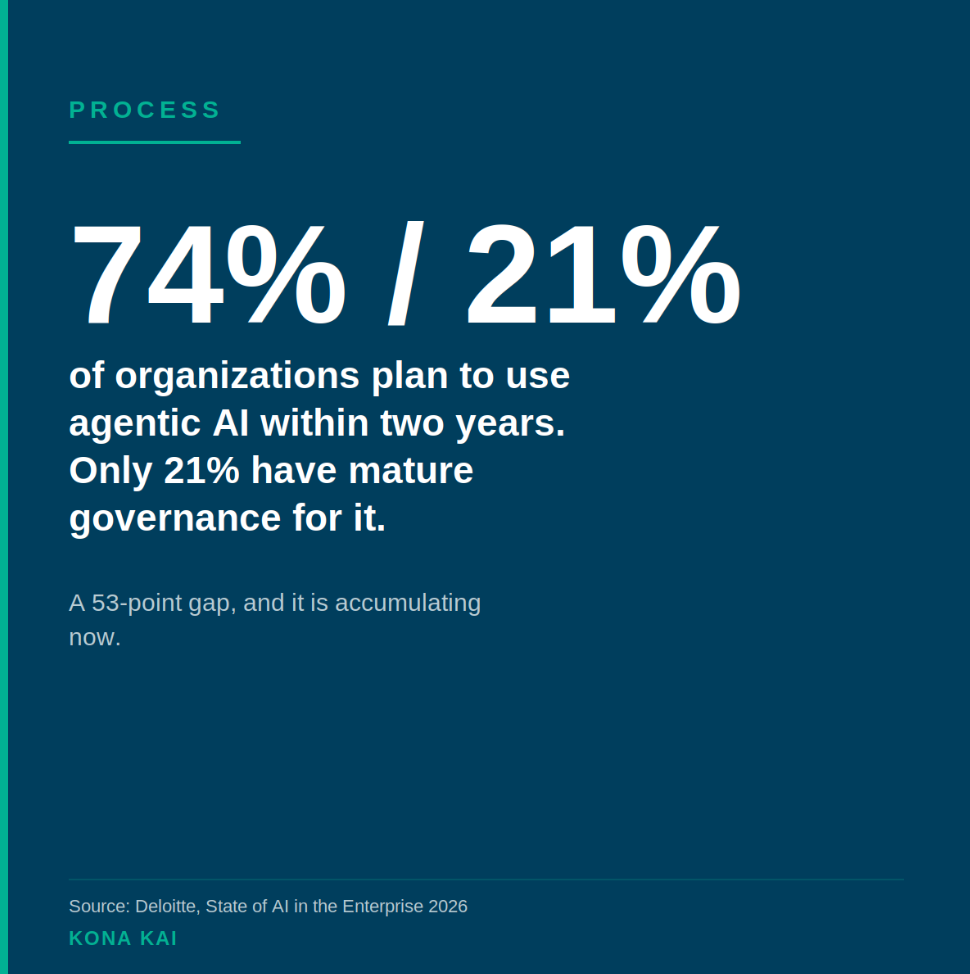
Deloitte's 2026 State of AI in the Enterprise report, based on a survey of over 3,000 director to C-suite leaders across 24 countries, found that 74 percent of companies expect to use agentic AI at least moderately within two years. Only 21 percent currently have a governance model mature enough to actually oversee it. That's not a rounding error. It's a 53 point gap, and it is accumulating right now, not on some future timeline anyone gets to plan around.
The reason the gap exists is structural, not a failure of effort. Every governance and workflow framework most organizations are running today was built for AI that waits for a human to ask it something. Agentic AI doesn't wait. It initiates, executes, and chains actions across systems on its own, and the workflows built around human initiated, human reviewed steps simply don't have a place for that kind of actor.
The World Economic Forum's January 2026 AI at Work report, drawing on insights from more than 20 major technology companies, makes the point directly: surface level automation produces surface level results. Real transformation requires rebuilding the workflow around what AI can actually do, not layering AI on top of a process that was designed for people. One healthcare organization documented by WEF took a lab order process from thirty minutes down to a few seconds, reclaiming roughly 30,000 working hours a year. That didn't happen because the AI was good enough on its own. It happened because someone mapped the process, found where time was actually being lost, and rebuilt the workflow before deploying anything.
There's a second distinction hiding inside this that most process frameworks miss entirely: the difference between design time and run time. Variability is useful when you're exploring what AI can do. It's a liability once that AI is live inside an insurance claims workflow or a clinical decision chain. A framework built for experimentation and a framework built for production are not the same framework, and treating them as one is exactly why AI outputs that perform brilliantly in a pilot become liability risks in production.
For healthcare, insurance, and banking specifically, here's where that gap turns from a governance conversation into an operational one. KPMG's Q4 2025 AI Pulse Survey found that 60 percent of organizations restrict agent access to sensitive data without human oversight, which means 40 percent do not. When an autonomous agent acts on a patient record, a policyholder file, or a credit decision without defined controls, that's not an abstract exposure. It's already arriving. Four process controls close most of that gap:
- Human in the loop trigger criteria: clear rules for when an agent's action requires human review before it executes, not after.
- Agent access governance: explicit policies for what data and systems an agent can touch, and when.
- Audit trail requirements: a documented, traceable record of what an agent decided and why, built for an examiner, not just for internal debugging.
- Escalation protocols: a defined path for what happens when an agent's behavior deviates from its expected parameters.
None of these are technology purchases. They're process decisions, and most regulated organizations haven't made them yet, largely because the org chart hasn't caught up either. When an AI agent's recommendation crosses claims, underwriting, and compliance in a single action, who actually owns that outcome? Most companies don't have a clean answer, and that ambiguity is itself a control deficiency, the kind that surfaces in an exam rather than a team meeting.
The organizations that will handle agentic AI well aren't the ones moving fastest. They're the ones who mapped the work before they built the tool, and who built oversight into the workflow instead of bolting it on afterward.
Kona Kai does the process mapping and control design that makes agentic AI deployable in regulated environments without creating exposure you can't see coming. If your workflows were built for a human that waits to be asked, and you're about to deploy an agent that doesn't, let's talk before the gap closes on its own terms.
Sources: Deloitte, State of AI in the Enterprise 2026 (74%/21% figures confirmed at deloitte.com); WEF, AI at Work: From Productivity Hacks to Organisational Transformation, January 2026 (30,000 hours example confirmed at weforum.org); KPMG Q4 2025 AI Pulse Survey (60% human oversight figure).
INSIGHTS