Trustworthy AI Starts With the Data You Can't See.
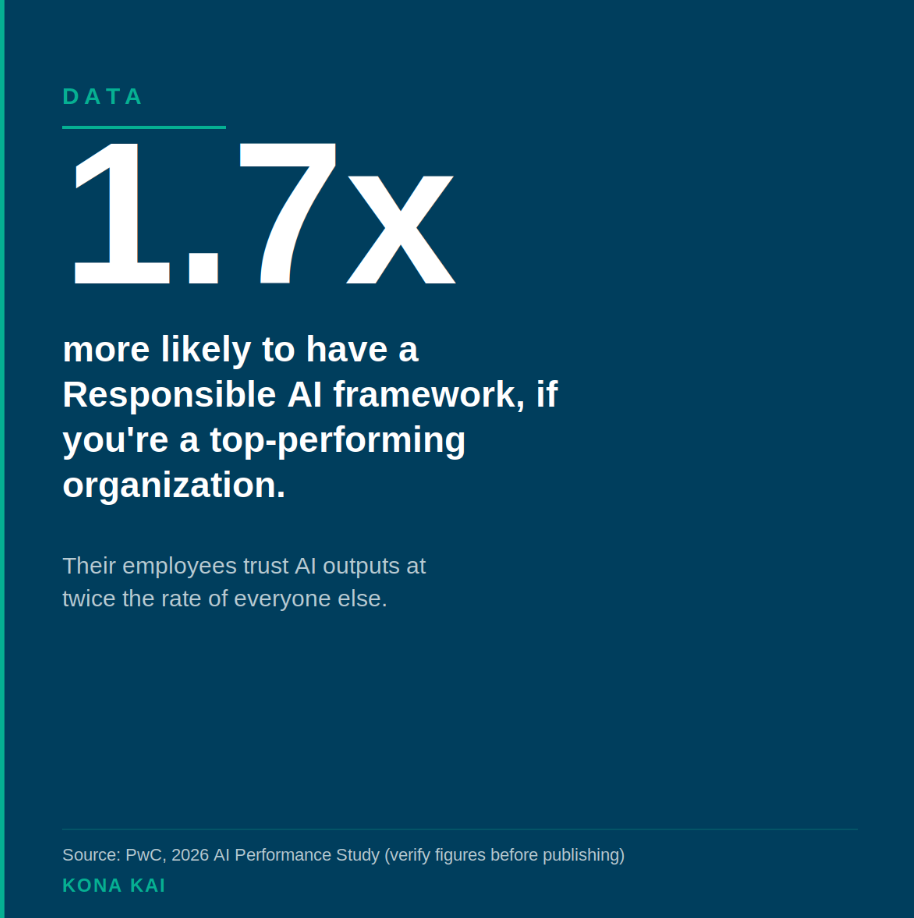
PwC's April 2026 AI Performance Study surveyed 1,217 senior executives across 25 sectors and found something that should reframe how every regulated organization talks about AI investment: nearly three quarters of AI's economic value is being captured by just one fifth of organizations. Not because that top fifth has better models. PwC is specific about the differentiator: those organizations are 1.7 times more likely to have a Responsible AI framework and 1.5 times more likely to have a cross functional AI governance board. Their employees trust AI outputs at twice the rate of everyone else's. The value gap is structural, not a matter of who bought the better tool.
That finding lands differently once you connect it to where trust actually comes from. It doesn't come from a more sophisticated model. It comes from knowing where your data originated, who touched it along the way, and what controls sat around it the entire time.
McKinsey's June 2026 research on AI data readiness makes the case that most organizations manage data like a storage problem when they should be managing it like a supply chain. A single PDF can expand into extracted text, tables, images, metadata, sensitivity tags, and quality scores, each one an intermediate artifact that AI systems reuse and recombine downstream. A small error introduced upstream doesn't stay small. It propagates.
This matters more in regulated industries than almost anywhere else, because the data causing the most exposure is usually the data getting the least attention. Structured fields get governed. Clinical notes, claim narratives, loan officer comments, and audit trails, the unstructured stuff, usually don't, even though AI systems depend on it heavily. Gartner and IDC both put the share of enterprise data that is unstructured at somewhere around 80 to 90 percent. McKinsey's own research doesn't cite that specific figure, but makes the same underlying point: unstructured content is where AI systems draw the most context, and where governance attention is thinnest.
None of this is an argument for waiting until your data is perfect before you deploy anything. PwC's 2026 Digital Trends in Operations Survey argues directly against that instinct: AI can help bridge data gaps, particularly through agents that reason using whatever data is actually available. The real mandate isn't clean data as a prerequisite. It's disciplined governance and iterative improvement running in parallel with deployment, calibrated to how much risk a given use case actually carries.
So what does that look like in practice for a CIO or CDO sitting inside a regulated organization right now? A few diagnostic questions worth asking before your next AI initiative launches:
- Where does data quality actually break down in your pipeline, and does anyone own fixing it?
- Is lineage visible for the data feeding your highest risk AI use cases, or is it assumed?
- Where do unstructured assets, like clinical notes, policy documents, and loan files, enter your systems without any governance attached?
- Have you defined what "good enough" data quality means for each use case, calibrated to its actual risk profile, rather than applying one standard everywhere?
Answering those honestly is uncomfortable in most organizations, because the answer is usually "we don't fully know." That's the point. You cannot govern what you cannot see, and you cannot trust an AI output built on a data foundation nobody has actually traced.
The organizations in PwC's top 20 percent didn't get there by waiting for perfect data or by buying a better model. They got there by treating governance as a financial performance variable, not a compliance checkbox, and by building the lineage and controls that make trust possible at scale.
Kona Kai's data supply chain assessment is built to answer exactly these questions before tool selection, not after. If you're not certain where your organization would land on that list, that uncertainty is worth resolving now. Get in touch to talk through what the assessment covers.
Sources: PwC 2026 AI Performance Study, April 13, 2026 (74%/20% figure and 1.7x/1.5x/2x multipliers confirmed directly at pwc.com); McKinsey, AI Data Readiness: The Key to Scaling Impact, June 2026; Gartner and IDC estimates for the 80-90% unstructured data share; PwC 2026 Digital Trends in Operations Survey.
INSIGHTS