The AI Skills Gap Isn't Going to Close on Its Own
AI is changing workforce training from a one-time project into a continuous business capability.
For decades, enterprise technology transformations have followed a predictable pattern.
A new system is implemented, then employees learn how to use it. Productivity dips for a while, then recovers as the organization adapts. Whether it was a CRM implementation, ERP modernization, a claims platform replacement, or a core banking upgrade, the skills gap eventually disappeared because the technology itself stopped changing.
AI is different.
Unlike traditional enterprise software, AI capabilities continue to evolve after implementation. New models are released, AI agents become more capable, and workflows change faster than most organizations can retrain employees. The result is a workforce that isn't simply learning a new system, but continuously adapting to one.
That fundamentally changes how organizations should think about workforce readiness.
Recent research from the World Economic Forum and Microsoft's Work Trend Index suggests many organizations already recognize the challenge. Are enterprises doing enough to prepare for a skills gap that may never close?
AI Changes the Rules for Workforce Training
Traditional enterprise software had a finish line. Once employees learned the new system, their knowledge remained valuable for years. Training programs could be planned, measured, completed, and archived because the technology itself remained relatively stable.
AI doesn't offer that stability. Employees who learned effective prompting techniques six months ago may now be using AI agents. Teams that started with document generation may now be automating entire workflows. Capabilities continue to expand, changing what effective work looks like almost as quickly as organizations can document it.
That means workforce readiness can no longer be viewed as a milestone that follows implementation, as it needs to become part of day-to-day operations.
The AI Skills Gap Doesn't End After Go-Live
The challenge isn't simply that AI is changing jobs. It's that AI itself keeps changing.
Foundation models continue to improve. New copilots are released. AI agents take on increasingly sophisticated tasks. Features that didn't exist six months ago become standard workflow tomorrow. Employees aren’t learning one “system” because they need to continuously adapt to new capabilities. Someone who learned the most effective way to use AI six months ago may already be working differently today.
Traditional training models weren't designed for that pace of change.
AI Is Reshaping the Workforce Faster Than Organizations Can Respond
The World Economic Forum's
Future of Jobs Report 2025 highlights just how significant this challenge has become.
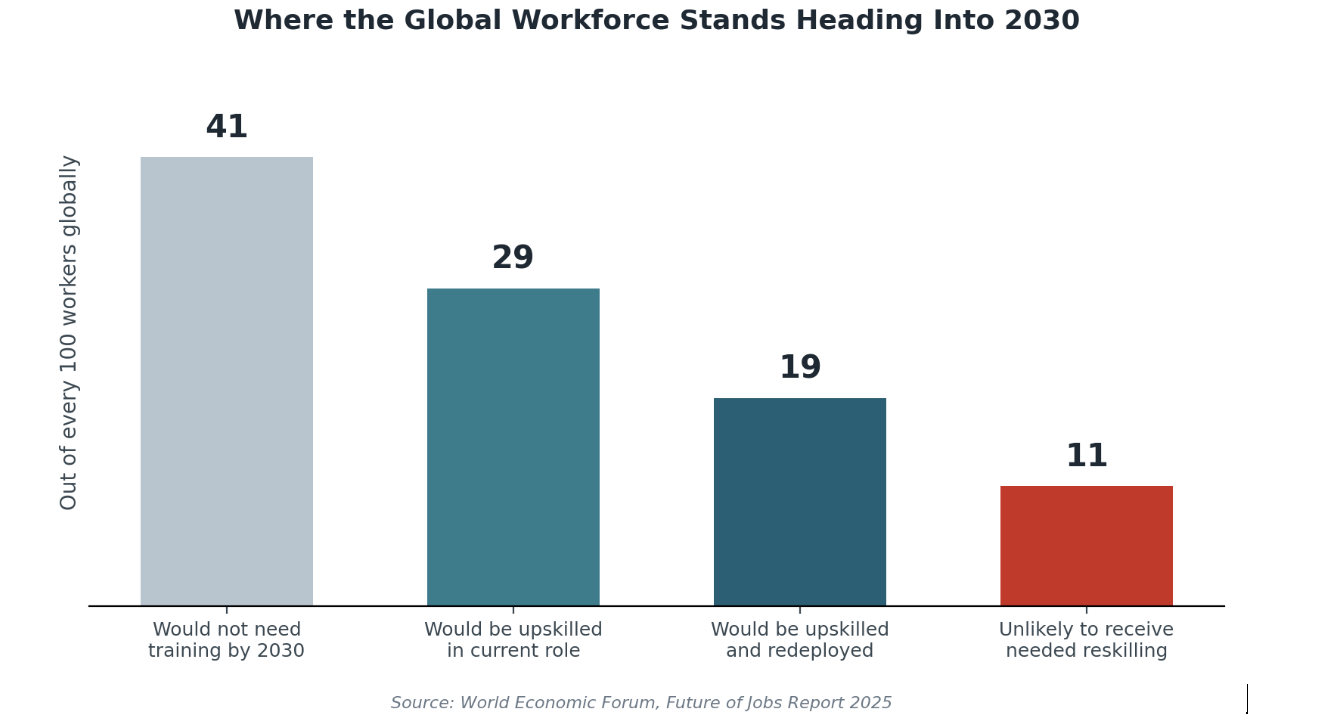
By 2030:
- 59% of the global workforce will require additional training.
- 29% can be upskilled within their existing roles.
- 19% can be reskilled into different positions.
- 11% are unlikely to receive the training employers believe they'll need.
That final statistic deserves attention, especially since it isn't an outside prediction. Employers are evaluating their own organizations and acknowledging that they don't expect to prepare everyone quickly enough.
For enterprise leaders, workforce readiness is far from a standard HR initiative. It's a real business risk.
Why the AI Skills Gap Isn't a Hiring Problem
Microsoft's 2026 Work Trend Index Annual Report offers another important perspective. Only a small percentage of AI users qualify as what Microsoft calls Frontier Professionals, which are employees who have moved beyond occasional AI use to redesigning workflows and building repeatable AI-enabled processes. Those employees consistently report significantly greater productivity gains than their peers.
Organizations don't appear to have a shortage of capable employees. They have a growing gap between employees who understand how to integrate AI into their work and those who are still experimenting with isolated use cases.
That requires a different response than simply hiring more people.
Skills Gaps Are Becoming the Biggest Barrier to AI Adoption
Organizations already recognize that workforce readiness is becoming a strategic priority. According to the World Economic Forum, Future of Jobs Report 2025:
- 85% of employers plan to prioritize workforce upskilling.
- 70% expect to hire for emerging skills.
- 50% plan to redeploy employees into growing roles.
- 40% anticipate reducing headcount because existing skills become less relevant.
Viewed together, these numbers tell an important story.
Organizations are planning to retrain employees, hire new talent, redeploy existing teams, and reduce roles, all because workforce capabilities are changing faster than traditional training models were designed to support.
Why AI Workforce Training Is More Complex in Regulated Industries
Healthcare, financial services, insurance, government, and other regulated industries operate within governance frameworks built around documented processes, repeatable controls, and predictable systems.
Those principles remain essential. But workforce training has traditionally assumed the technology being governed was relatively stable. Organizations now have to maintain governance while continuously helping employees understand new capabilities, new risks, and new ways of working.
The goal is to ensure employees can use AI safely, effectively, and consistently as technology evolves.
The old assumption: a stable underlying system justified training programs that were stable, auditable, and finished by a certain date.
The new reality: when the tool itself keeps changing, a defined end state is a target that's already gone by the time you hit it.
For CIOs, CTOs, CFOs, and CROs, that means the heaviest compliance and documentation burden in the business is being applied to a training model built for a world that no longer exists.
Continuous Learning Is Becoming Part of Enterprise Operations
Organizations don't treat cybersecurity as a one-time project. New threats emerge continuously, so security becomes an ongoing operational investment.
AI should be viewed similarly. As models improve and workflows evolve, workforce education becomes part of maintaining the technology itself. That doesn't mean organizations need constant formal training programs, but they do need repeatable processes for helping employees understand new capabilities, evaluate changing risks, and adapt how work gets done.
Organizations that build those habits will likely adapt much faster than those relying on one-time enablement efforts.
Planning Beyond AI Implementation
Most enterprise AI conversations focus on selecting models, deploying copilots, or identifying high-value use cases. But the organizations that realize the greatest long-term value from AI will likely distinguish themselves in another way: how they prepare their workforce after implementation.
Enterprise leaders should begin planning for continuous workforce development alongside their AI strategy by:
- Treating AI training as an ongoing investment rather than a one-time rollout.
- Building governance that evolves alongside AI capabilities.
- Regularly evaluating how AI is changing business processes and employee responsibilities.
- Viewing workforce readiness as an enterprise risk—not simply an HR initiative.
Technology will continue to evolve. The organizations that keep pace won't necessarily be the ones with access to the newest AI models. They'll be the ones whose people can continuously adapt alongside them.
At Kona Kai, we help organizations identify where AI can create measurable business value while building the governance, operating models, and workforce strategies needed for long-term success.
INSIGHTS