AI Literacy Isn't Training. It's an Operating Model.
Deloitte's 2026 State of AI in the Enterprise report names the AI skills gap as the single biggest barrier to integration right now, ahead of budget, ahead of technology maturity, ahead of everything else on the list. Education was the number one way companies say they adjusted their talent strategy in response to AI. And yet most organizations still treat training as an event. A workshop. A certificate. A box that gets checked once and never revisited.
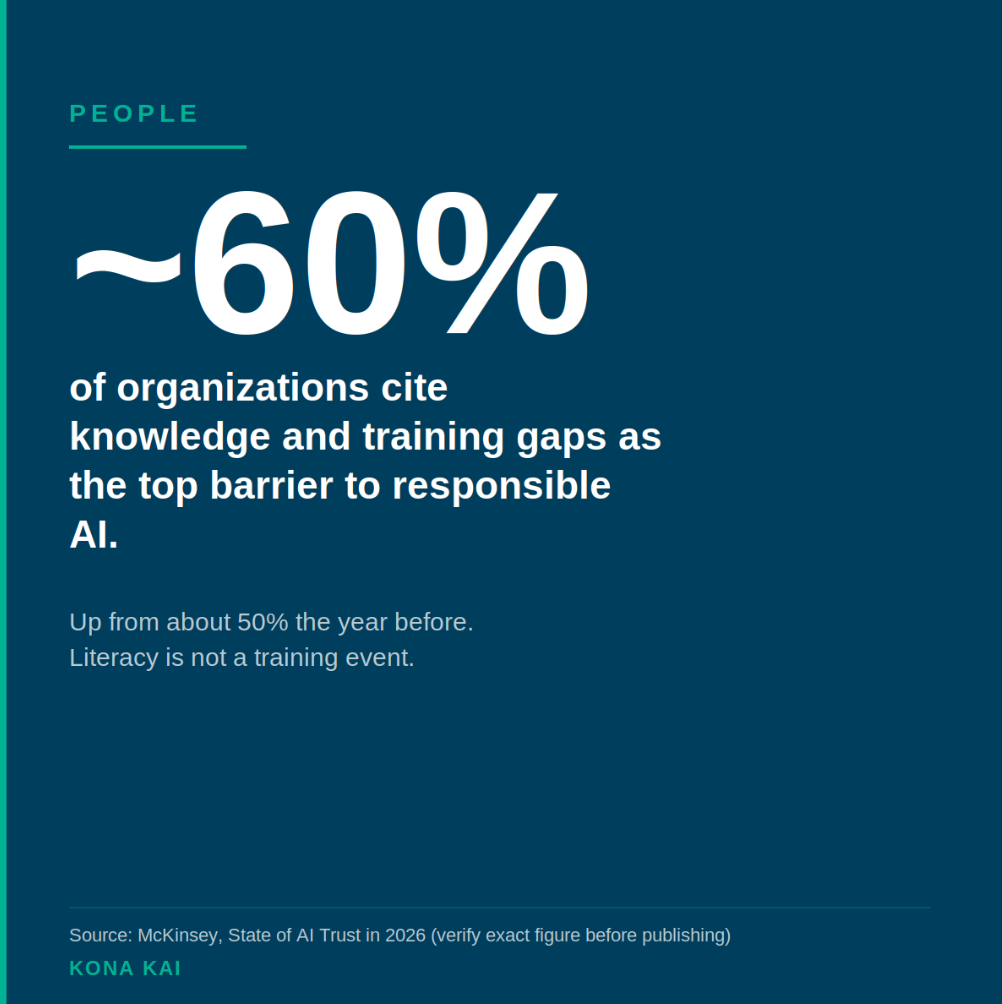
That mismatch is getting more expensive, not less. McKinsey's 2026 AI Trust Maturity Survey found that nearly 60 percent of organizations now cite knowledge and training gaps as the primary barrier to implementing responsible AI practices, up from about 50 percent the year before. The gap is widening while the spend on closing it goes up. Something in that equation is broken, and it isn't the budget.
Here's what's actually broken: the unit of measurement. A two hour workshop teaches someone to use a tool. It does not teach a claims adjuster when to trust a model's output and when to escalate. It does not teach an underwriter how to explain a decision AI helped make to a regulator who is asking hard questions. It does not teach a compliance officer, who was never trained to evaluate AI systems, how to audit one. Roles like AI Compliance Officer and AI Ethics Consultant are up roughly 45 percent year over year, driven almost entirely by regulatory pressure, and generic compliance training does not cover model auditing, bias testing, or decision traceability. That's a different skill set, not a refresher course.
The organizations getting this right have stopped measuring completions and started measuring capability. That distinction sounds small. It isn't. Completions tell you who sat through a session. Capability tells you whether someone can do their job differently, and better, because of it. What capability actually requires, by role:
- Frontline and transactional roles need to know the boundaries: when the AI's output is reliable enough to act on, and when it needs a human to step in.
- Underwriting, claims, and clinical roles need enough fluency to explain an AI assisted decision to a regulator, a patient, or a policyholder, in plain language.
- Compliance and risk roles need genuinely new technical skills, like model auditing, bias testing, and traceability, not a rebranded version of existing compliance training.
- Leadership needs enough literacy to ask the right questions of the teams deploying AI, not just enough to approve the budget.
None of that happens in a single workshop, and none of it happens outside the flow of actual work. Effective upskilling has to live inside the job itself, not in a separate room down the hall. That's the real difference between a training program and an operating model: one is an event people attend, the other is a capability the organization builds into how work gets done.
There's also a structural risk hiding in this gap that most C-suites haven't priced in yet. In insurance specifically, a multistate NAIC pilot of an AI Evaluation Tool is running through September 2026 across twelve states, giving regulators a structured framework to review insurer AI systems during market conduct exams. That's a compliance conversation on the surface. Underneath it, it's a workforce conversation, because a workforce that isn't equipped to explain its own AI systems is a workforce that fails that exam.
Healthcare and financial services show some of the most critical AI talent shortages anywhere, with average time to fill AI related positions running six to seven months. That's not a hiring problem you solve by posting more job listings. It's a capability problem you solve by building literacy into the roles you already have.
Kona Kai designs workforce enablement embedded in the actual workflow, not a course catalog. If your organization is measuring completions and hoping that's the same thing as readiness, let's talk about the difference before an exam, an audit, or a bad outcome makes it obvious.
Sources: Deloitte, State of AI in the Enterprise 2026; McKinsey, State of AI Trust in 2026, March 2026 (nearly 60% figure confirmed directly at mckinsey.com); HeroHunt and other aggregator research for the ~45% AI governance role growth figure, which is repeated across sources but not traceable to one named primary survey; Crowell & Moring / Fenwick NAIC pilot coverage.
INSIGHTS