Explainable AI Is the Adoption Strategy Health Payors Are Missing
Explainable AI (XAI) means an AI system can give a clear, traceable reason for a specific decision, not just a probability value.
For health payors, this isn't a technical nice-to-have. It's what determines whether members, providers, and regulators trust an AI-assisted decision enough to accept it.
Here's why that distinction is now board-level, not just IT-level:
1. The Advisory Tale Is Already in Federal Court
- Litigation with Healthcare Payer related to Medicare coverage
- Judicial requirement over internal documents on how tools were built and used, including whether it was designed to override physician judgment.
- The lesson isn't about one vendor. It's that when a payor can't produce a clear rationale for an AI-influenced decision. That gap becomes the story, even if the decision itself was defensible.
2. Regulators Are Formalizing What Trust Looks Like
- NAIC Model Bulletin (adopted Dec. 2023): twenty-four states and the District of Columbia now expect insurers to notify consumers when AI contributes to decisions and provides explanations of adverse outcomes in plain language.
- CMS-0057-F (effective Jan. 1, 2026): covered payers must respond to urgent requests within 72 hours and standard requests within 7 days.
- Starting March 31, 2026: those same payers must publicly report turnaround times, denial rates, appeal rates, and overturn rates.
- Payors are being asked to move faster and explain themselves better and in public, at the same time.
3. Speed Is Not the Same as Trust
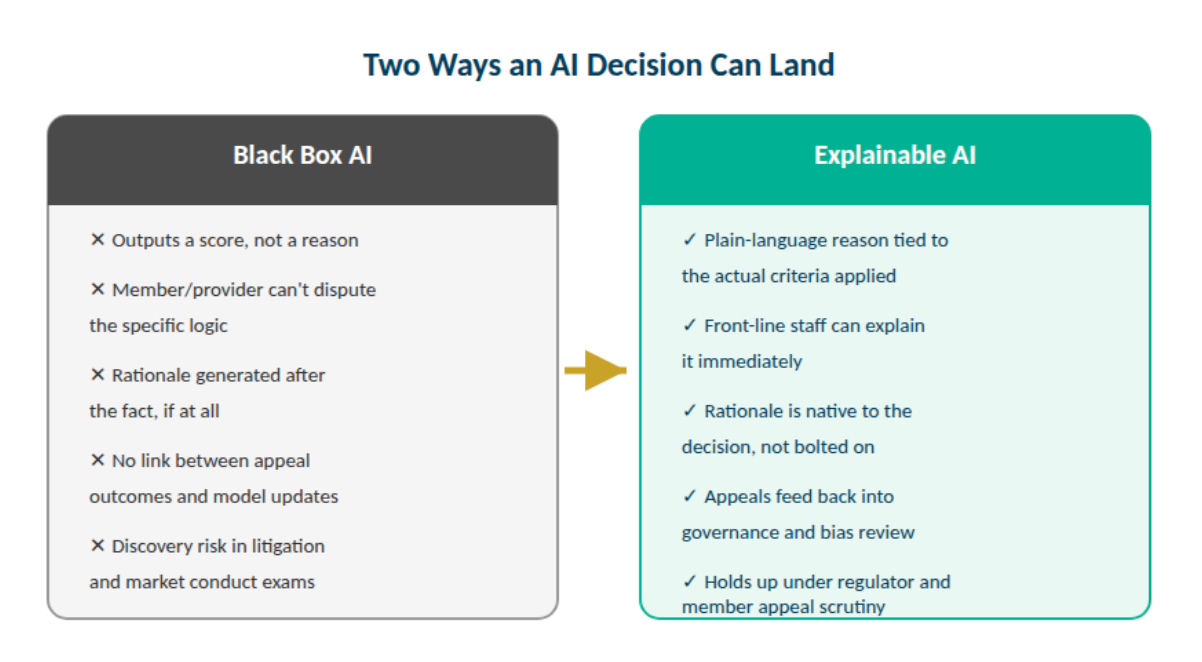
A faster black-box denial doesn't earn a payor member trust or provider goodwill. It means erosion happens faster. A member who gets a same-day denial with no comprehensible reason isn't more satisfied than one who waited a week for the same non-answer. Real adoption, the kind that protects a payor's brand and loss ratio, depends on people trusting the reasoning, not just tolerating the speed.
4. What Operationalizing XAI Requires
- An audit trail linked directly to the clinical or policy criteria the system applied, not a rationale generated separately by systems or staff after the fact.
- A plain-language explanation that a call center rep or provider portal can surface immediately, no data science translation required.
- A human-in-the-loop escalation path for borderline or high-risk cases.
- Appeals outcomes that feed back into model governance and bias review as standard practice, not a side process nobody on the model team ever sees.
Frequently Asked Questions
What is explainable AI in a health insurance context?
An AI system's ability to produce a specific, traceable, plain-language reason for an individual decision, tied to the actual criteria it applied, not a general description of how the model works.
Does explainability slow down AI-driven prior authorization or claims processing?
Not when it's built into the architecture from the start. Delays typically happen when organizations try to generate an explanation after the fact, separate from the decision engine itself.
What should payors have prior to scaling AI into utilization management?
- A documented AI governance program that satisfies NAIC Model Bulletin expectations.
- An audit trail connecting each decision to the specific criteria applied.
- A plain-language explanation capability available to front-line staff and providers.
- A feedback loop from appeals data back into model oversight.
If your organization is building or scaling AI in utilization management, claims adjudication, or care management, we'd like to talk about what an explainability architecture looks like for your specific stack.
Primary Sources
NAIC Model Bulletin on the Use of Artificial Intelligence Systems by Insurers (adopted Dec. 4, 2023), official text: content.naic.org
CMS Interoperability and Prior Authorization Final Rule (CMS-0057-F), official fact sheet: cms.gov
INSIGHTS